Thursday, March 12, 2009

Convergence

There's a bunch of openings tomorrow in River North. Brave the cold and see openings at Bae, Edelman, Cooper, Glimer, Gruen, Habatat, KH, Perimeter, Roche and Zolla / Lieberman.

Cathy will be showing Achim Lippoth, a German photographer known for his striking pictures of children. When I stumbled upon his Together #12, I was struck with what Lawrence Weschler calls convergence. It totally reminded me of Jill Greenberg's photograph of adolescent boys play fighting. There's something wild to me about the fact that these two shots exist the way the do. They could be the same boys, just years apart. There must be something larger behind the composition, something revealing something innate about us.

I was possibly more struck by the fact that I couldn't find Jill's images of adolescents fighting anywhere. I mean, like, anywhere. I went over 50 pages deep in google images. They have been removed from her official site and are nowhere to be found. Very odd. I have a screen shot of one from a proposal I did for the Elmhurst Art Museum a while back. I'll really know if someone is reading this thing if I eventually get a removal or desist request from Jill or her representatives. So, Jill's image will remain untitled and unlabeled here because I have no place to verify that info.

I'm assuming they've been removed in anticipation of Clamp Art's show Kids Behaving Badly (which I remember being the title of Greenberg's series, but I could be wrong) which opens on the 19th in NY. Check if out if you're there. Should be an outstanding show with the likes of Nan Goldin, Larry Clark and David Armstrong among others.

Achim Lippoth, Together #12, 2004


Jill Greenberg, from (possibly) Kids Behaving Badly series

Tuesday, March 10, 2009

Chi Votla

The Armory and Volta were last week. There are still people arguing here in Chicago about the tone of Volta seeing as it has space in NY and Basel, but when (essentially) the same show comes to Chicago, it's called NEXT. There's arguments to be made for both sides (which if you want to get into you'll need to have a beer with me), but Volta NY currently has three Chicago galleries represented.

It is by no means a bad representation, quite the contrary, but it does raise it's suspicions. Kavi's the founder, and far be it for me to claim that he shouldn't be here considering that David does show in his own gallery, but, David leaves that decision to a Curator (yours truly), yes, one that he pays, but one which I think we could all argue does his best to stay unbiased and ethical. Then you've got Andrew Rafacz, whose gallery I've loved since it was BucketRider, and who I think is an amazing curator and who represents one of my favorite artists, Cody Hudson, but who also pays rent to Kavi. And then there's Walsh, who has great programming for a niche market, but who is within steps of Kavi's (and Andrew's) space. It just makes me wonder if Kavi visits outside the realm of where he parks his car in the morning, but I suppose I'd be making the same argument if Walsh was swapped with Meloche, who'd easily be just as deserving of a spot, and for all I know, was offered and declined. Meh. Should have been a really good representation anyway.

Volta's programming requires that there only be one artist in the booth, which is a refreshing change and a great idea. It tends to focus the viewer while at the same time wearing them out less. Walsh is focusing on one of my very favorite Chicago artists, Von Kommanivanh. Von's work is spoken in terms of Basquiat all the time. Now, I love Basquiat, really, and Von's work does owe some of its postmodern strokes to his work, even dropping in the tell-tale crown in Crooked Characters. There's even tiny little crowns in America in Gray, but which owes a larger debt to Klimt. Von's work is far too complicated to distill it to any similes though. It is completely unto itself and remains some of the most powerful work I've had the pleasure to stand for a very long time in front of. When Flatfile was above Walsh, I would go down and sit on the floor in Julie's space and just stare at Von's work. Its simultaneously aggressive, scrappy, thoughtful and delicate. It's this sense of effective dichotomy that lends great strength to Von's canvas'.

Von Kommanivanh, Crooked Characters, mixed media on canvas, 8' x 10', 2005


Von Kommanivanh, America in Gray, mixed media on canvas, 2005, 102.5" x 106.5"


Von Kommanivanh, Reform Nuisance, oil on canvas, 2003, 70.5" x 59"


Von Kommanivanh, This is Rhythm, mixed media on canvas, 2005, 119.5" x 146"


Von Kommanivanh, Untitled, mixed media on canvas, 2005, 81" x 83"


Rafacz is showing Jason Lazarus. One of Jason's prints, Self portrait as an artist burning down the Museum of Contemporary Art, has a dear place in my heart. I wish I had come up with it. But that's what Jason does. He shoots in a deceptively simple manner with striking results. We all should be able to take the shots that he's got, but we're never aware that way or never have a camera handy or, frankly, aren't that good of photographers. His shot of the lights at the Obama rally is something that is extremely hard to capture even though it looks like it's virtually nothing. Check out his website for that shot - it won't really look that good reproduced here. I hope that Andrew does well with Jason, if for nothing else, so that he can do a booth again with Cody Hudson. I'm sure I'll mention it again and again, but Cody made the very first piece of art that I offered to buy without knowing what the price was. Unfortunately it was already sold, and what later killed me is that it sold for, like, $200 or $400 or something ridiculous. Next time I'll get a preview.

Jason Lazarus, Self portrait as an artist burning down the Museum of Contemporary Art (Chicago, IL), 2004


Jason Lazarus, Self portrait as an artist making something contemporary, 2004


Jason Lazarus, Wall of Fire, Labor Day, 2006 (Cleveland, OH), 2006


Kavi, whose gallery is a mystery to me, will be showing Angelina Gualdoni. I'm not familiar with Gualdoni's work, but it looks really nice. Kavi's programming is, for me, very hit or miss, but I've heard it argued that my emotional response to the shows reveals the strength of the art. I'm not convinced that just because I hated Sterling Ruby's Inscribed Monolith (EPA-Alabaster) that it was any more effective because of my emotion. I'm pretty sure it just sucked. And, yes, Jeff Carter, Hans Hemmert and, yes, I'll say it, even Ciaran Murphy kind of bug me most of the time. But then he shows Melanie Schiff (last year's Volta booth) and my hatred melts away, because I pretty much love Melanie's work. If you couldn't check out Angelina's work at Volta, just show up at Kavi's sometime between March 27 and May 9 of this year to see her works installed.

Angelina Gualdoni, Given Ground, We Build it Everyday, acrylic and oil on canvas, 42 x 36, 2009


Angelina Gualdoni, Letter from the Generations, acrylic and oil on canvas, 48 x 72, 2006


Angelina Gualdoni, Blush, acrylic and oil on canvas, 60 x 48, 2008

Friday, March 6, 2009

So it's not like it is news to that many people anymore, but Flatfile is closing. It's strange to type that. Flatfile is closing.

I can't really pinpoint my emotions about it. It's like some sort of dull sadness. Like how you'd feel if you asked how someone's day was going and they said, like, their dog died last week, and you'd feel legitimately sad for that person, but you, like, don't know that person or their dog, so, within a minute or two, you just go back to what you were doing. Except in this equation I guess I know the person. And the dog. I don't know.

You know how you sometimes get your heart broken, but then you have to man up and be like, well, if I got my heart broken, then the other person probably go their heart broken, just maybe not the same way or at the same time or in the same place. Maybe. I don't know.

I guess whatever it's like, it is certainly like the largest square foot gallery closing in Chicago. Whatever my emotional ambivalence, it seems like a loss. Rhona was overheard saying, not about Flatfile, but about all the galleries that have been closing in general, that it's just the nature of the business. When we went down to talk to Ginny about the cover of Chicago Gallery News, she showed us brochures from 1990 and I didn't recognize, like, 2/3 of the galleries listed. Galleries come and go and the ones that stay, well, they are the ones that stay.

It will be interesting to see where all the artists shake out. When Fassbender closed, Flatfile and Alfedena took on a lot of the programing. Now that both those galleries are closed, along with countless others, it will be a while before a significant amount of legitimately great artists get substantial shows in Chicago. Here's to hoping some (or all) get some great shows in New York in the meantime.
Michiko Itatani, Visitors, 2005, Oil on Canvas, 72x84

Thursday, March 5, 2009

LeBourgeois at Packer

A couple of weeks back I went gallery hopping and stopped by Aron Packer's opening. In the lower space of his gallery, or "The Lab," he has some great stuff, including works by Louise LeBourgeois. Louise has shown well in Chicago at galleries like Lyonswier, Gescheidle, Alfedena, Printworks, and now Packer.

Her work is simply installed and there's something like four paintings on the wall of what most would call, small size (12x12.) They were a highlight of the evening, but if I'm honest about it, one in particular left a deep impression on me. It is a piece titled Still Water. So I went about getting an image of it a few days ago and was thoroughly confused when I tracked it down on Louise's website and it was . . . well, it was upside down. And I thought, well that's a funny mistake. Except of course, it wasn't a mistake, because I also found it on her flickr account and there were several comments on it. I said to myself that there was no way the artist posted it in two different places, upside down, with comments.

So yesterday I went back to Packer and went straight down to the Lab and there was the piece, just like it was on Louise's website. Well, now I thought maybe I was loosing it, so I went up and asked Aron if it had always been like that. Long story short, it had been placed upside down at Aron's the night of the opening.

But this puts me in a weird spot as someone who should be part of the art intelligentsia (thought I'd never claim to be.) I'm sitting here, as a curator, thinking that the piece is actually significantly better upside down. It takes on a whole new abstract level. It becomes less straight forward and more dream like. I actually laughed when I first saw it because I thought it was witty and smart and showing me something I hadn't thought of. Essentially it's a simple landscape of three evergreen type trees in a field near the waters edge and the reflection of that scene in the water. The composition is set up in a sort of 1/3 or maybe even 1/4 manner with the physical reality in the upper 1/4 and the reflection in the bottom 3/4. The reflection is slightly blurred as if a hush of wind has disturbed the surface without making any waves or ripples.

But, if you flip the piece 180, the nature of the whole thing changes drastically, especially when you consider the title. You start with the visual of the upper 3/4 of the piece that, rather than looking hushed, looks disturbed. It's not quite like haze through heat. It's more like what you feel like you'd see seconds before a blackout. Like if you fainted in a field, this is what you'd see. Except that the reflection in the water is crystal clear. What was the land and sky is now the reflection in water, but the reality is blurred and the reflection is actually clearer. It was a little rabbit hole moment for me and I thought it was charming and funny and smart in terms of an artistic decision.

But of course, it was neither a decision nor an intention of the artist. And evidently she said, like, hey Aron, that's upside down. I hate to admit that I had such an emotional resonance to the work when that was not the intention. I know how hard artists work toward an idea and Louise's work exhibits an exceptional hand. But I also know that once you make it and show it and it's out there, then it's out there and people see what they think they see, not always what's there. If I bought it, it would definitely hang the way I first saw it - sorry, Louise.

Louise LeBourgeois, Still Water, oil on panel, 2009, 12x12
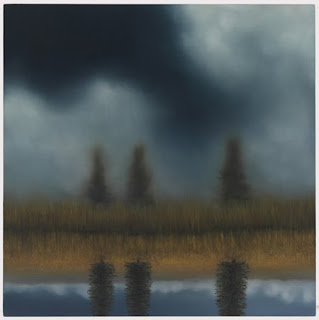
Louise LeBourgeois, Still Water, oil on panel, 2009, 12x12 (upside down)

Saturday, February 28, 2009

A place to be from

So, obviously most of what I write here will relate to the goings-on in Chicago. But occasionally I'll travel around to NY or Miami or wherever and I'm sure I'll be finding artwork there too. So while I probably won't get around to seeing it, if you have the means then you must see the Tara Donovan exhibit at the CAC in Cincinnati.

From the CAC's website: "This exhibition is the first major museum survey of the American sculptor Tara Donovan. With sensitivity to texture, volume and the inherent physical properties of materials, Donovan transforms large quantities of mass-produced items [such as] toothpicks, adhesive tape, straws, buttons, pins, plastic cups and Mylar, into stunning sculptural objects and installations." And, "Her methodology of building sculpture through accumulation and meticulous assembly of quantities and amounts of identical items offers the viewer the experience of complexity and infinity."

Tara Donovan, Untitled, plastic cups

We are proud, at David Weinberg Gallery, to have been introduced to Tara through Ren Weschler and were overjoyed at the opportunity to show her work in our space. She is a humble and approachable young woman with talent like a halo. She walks around and sees things differently than you and I and makes sure we rethink the simple ideas of mass and structure. Often interested in objects with no inherent color, i.e.. clear or white, Donovan likes to explore the latent color of that object en masse. Where several million clear straws become a yellow beehive. Where millions of near-clear plastic cups become icebergs. Where reflective mylar tape becomes a kaleidoscope. She's great. Don't miss it if you have the chance to see it.

Tara Donovan, Untitled, toothpicks

Tara Donovan, Untitled, styrofoam cups

The CAC has an amazing history. When I was in Cincinnati, it was always a great space to see artwork. Thoughtfully curated and expertly managed, it was by far the best space to see contemporary works - even if it was above a Walgreens in an ugly box building in Downtown Cincy. It is now an incredible piece of architecture designed by Zaha Hadid as well as one of the premier houses of art in America.

Back in 1990, the curator Dennis Barrie was thrown in jail for obscenity charges for displaying the works of Robert Mapplethorpe. He was, thankfully, found not guilty of those charges and the acquittal of the Mapplethorpe defendants was a major reaffirmation of First Amendment freedom of speech. And Kudos to my mother for taking me (all of age 11) and my sister to see the show and talk to us in an open manner about what the artwork was and what it was supposed to do or say.

Probably the one show I wish I could have seen and didn't get to at the old CAC was Pat Renick's 2068 series. It was a series of fiberglass boat / coffin structures that were reflections on states of consciousness during an episode of her hospitalization in the 1950's. Pat had been given a prescription for what is essentially speed and because of the ingestion of that prescribed drug (which was intended for weight-loss) Pat began to exhibit symptoms that resembled schizophrenia. She was hospitalized unnecessarily and given shock treatment for her "disorder." Her case number was 2068. After more than a year of these painful and needless "treatments" she was finally properly diagnosed and released.

These haunting figures, which are exhibited in an arch, become less human as you progress across the curve of the installation and grow more and more mechanical and suffocating in nature. I have only ever seen photographs of the installation, but let me tell you, when Pat was around to tell her story, everyone listed with their hearts and minds as open as they could manage and you got a vivid sense of what she was trying to say. Remarkable stuff. She'll be loved forever by innumerable beautiful souls.

Pat Renick, from installation of 2068

Friday, February 27, 2009

walk the walk

Google maps is fun, right? Well, one day, not too long ago, I was trying to find my way to an artist's studio and I noticed that google maps offers driving directions, public transportation directions and walking direrctions. Now, I'd never noticed the walking directions and I had no intention of walking the however-many-miles it would have been to walk, but I clicked anyway. And instantly I had walking directions.

Well, far be it for me to stop there, so I said to myself, I wonder how far this thing will tell me to walk if I ask it. So I typed in "destination a" as Los Angeles and "destination b" as New York City and, click, instantly I was fed 795 distinct directions for walking from LA to NY. Suffice it to say, I was a little surprised by the quickness and the scale of the answer. There were directions for walking 16 feet before the next direction. It took you through Bagdad, Arizona. Yes, my spelling is correct and yes, there is a Bagdad, Arizona. It even takes you on Yellow Brick Road. It's in Pennsylvania. The amount of data made me more and more curious about the whole thing, walking from one side of our country to another, and so I started thinking of projects to do inspired by it.

But damn it if someone hasn't already done it. As in, walked it!

From his website: "In January of 2002 Aaron Huey and his dog Cosmo walked from Encinitas, CA to Coney Island, NY. The journey, which totaled 3,349 miles, took 154 days. There was no press, no cell phone, and no support team. Just the great unknown."

Now don't get me wrong. I wasn't ever planning on walking it. I was thinking of more, like, works on paper about it. But Huey is not like the rest of us. Not only has he walked across America, but he has also documented poppy eradication in Nangarhar Province, East of Jalalabad and also outside Tarin Kowt, in Oruzgan Province. He has shot in the Pine Ridge Indian Reservation. He has photographed high in the mountains of the Georgian Republic, between the breakaway republics of Abkhazia and South Ossetia. Oh yeah, and he hitchhiked across Siberia.

I am extremely grateful that people like Huey exist. He lets us in on things that most of us can only abstractly think about. He goes out and does them. Both insane and great.

from his walk across America, self-portrait


from his walk across America, self-portrait with Cosmo


from the front lines of the Afghanistan drug war


from Pakistan after the assassination of Benazir Bhutto


from the Los Angeles fires in late 2008

Sunday, February 22, 2009

On one of my more meandering type strolls through the internet (from facebook to Rachel Bank to Helsinki Biennale to Erin Jane Nelson) I came upon the works of a young student in New York. Nelson's blog is odd and charming in that sort of very young way that seems not to have particular thoughts about ego. It just exists in that nice way that things can just be done quietly.

While going through her images I came across several series that I liked but the ones that struck me were her photographs of rainbows, or more particularly, refracted light through glass, on the faces of what I assume are friends or close acquaintances. They have a lightness and looseness that suggests a keen awareness of the moment. They seem to be composed entirely of the moment, like, 'hey, wait a minute, there's a rainbow on your face. Let me take a picture of that.' You can almost hear the silence in One Way I Could Never Touch You - which I desperately hope is the title of the work (it is at least the title of the jpg.) But just as you can feel that calm during the instant click, you can almost imagine the young girl turning towards you, eyes fluttering open and giggling back into whatever everyday conversation she was having.

Erin Jane Nelson, One Way I Could Never Touch You

It is extremely hazardous to shoot your friends as a photographer, because you often fall into one of two camps. One, you're not as unique and special as you think and neither are your friends, which makes for dull and empty pictures, or, two, you end up exposing some sort of shallow self reflection in the vein of early Tillmans work or Elizabeth Peyton's recent foray into photography. Nelson's thankfully skirt both these pitfalls, and in the end, feel honest and not amateur.

Erin Jane Nelson, from continuing (I hope) series of photographs of "Valerie"

They reminded me of Tracey Baran's work. I first came across Baran's Suck and Blow image a long time ago. In doing some research on it, I feel like I must have picked up something from the MoCP back in 2002 when I was interning at flatfile. Karen Irvine, Associate Curator at MoCP said of Baran's work, that she "creates visual journals, using color photography to record and refine her experiences into images that reference fundamental themes such as love, death, and regeneration. Rarely preconceiving her pictures, Baran works in an intuitive manner, casting her photographer’s eye on the world until something sticks."

Tracey Baran, Suck and Blow, 2002

Her images are at once beautiful and sad. They feel like when you can't remember the details of a dream but you can remember the emotional content. You feel like you have lost something, but the visual exchange gives you something back. Its rare than an image will stick so hard in my head but that I can't hold onto the information. The image was seared into my mind the second I saw it, but I was too involved with other things to really pay attention. I never saw the show at the museum. I remembered the image and had thought about it often until last year's Volta fair where a gallery from Berlin was highlighting her works. I was very excited to see someone commit to her creations that way.

So I was very sad to find out today that on November 11, 2008 Baran passed away at the age of 33 due to complications from seizures. I felt like I was just rediscovering her works and now the feel lost again. She will be missed.

Tracey Baran, I Miss You Already, 2004